Curious about Art Therapy?

“By awakening your creativity, Art Therapy can help you to connect with yourself in order to better understand your emotions and relationships within the world, leading to positive change.”

Sometimes it can be difficult to say how we feel. Sometimes we may not know what we are feeling, let alone how to articulate this. Other times, we may feel we know what to say but have lost our ability to live authentically. Art Therapy is a form of psychotherapy that uses art-making and creativity as its main mode of expression and communication; art is not used as a diagnostic tool but as a medium to explore and address confusing or distressing emotions, feelings and behaviours that may not be revealed using words alone.

I believe everyone is innately creative, but we often lose touch with this as we grow up and become more self-conscious (and often, self-critical) and reliant on language. By awakening your creativity, Art Therapy can help you to connect with yourself in order to better understand your emotions and relationships within the world, leading to positive change. Therefore, no previous experience or knowledge of art-making is needed in order to benefit from Art Therapy.

As an accredited Art Psychotherapist based in Devon, I provide face-to-face Art Therapy for adults and children who have a range of difficulties and/or diagnoses, such as depression, anxiety and relationship issues. I have experience of facilitating one-to-one and group Art Therapy for people with a variety of mental health conditions, of all ages, and from diverse social, cultural and religious backgrounds within the NHS, community, charity and educational settings.

Art Therapy theory is influenced by psychoanalysis and attachment-based psychotherapy, drawing upon the relationship and unconscious processes at play between client and therapist. My training is grounded in Psychodynamic Psychotherapy and my approach is informed by Feminist theory and Ecotherapy. I can also incorporate other client-focused approaches such as Mentalization and Psycho-education depending on specific needs.

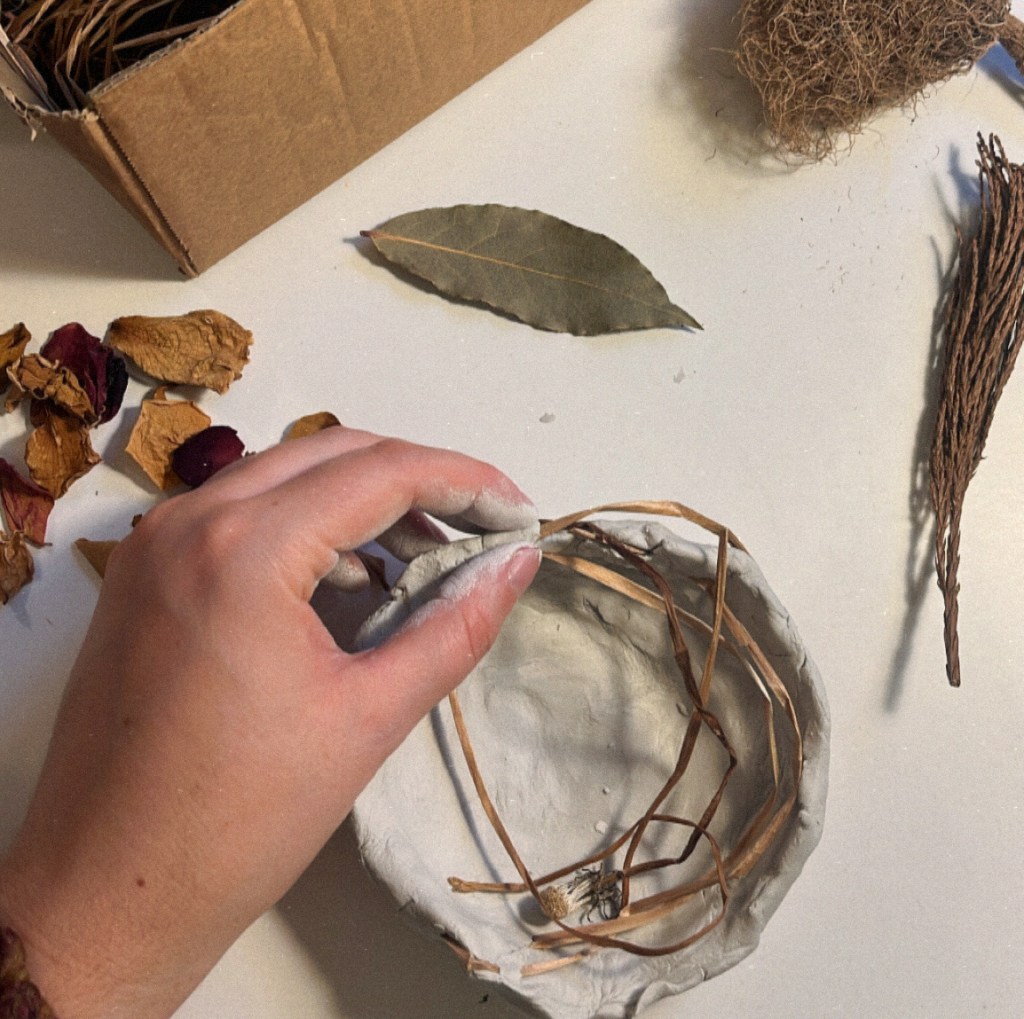
I advocate for Art Therapy for social & environmental change and justice, and align my practice with an earth conscious approach. Rather than using conventional art materials, I provide eco-friendly and non-toxic art materials. This can be particularly supportive for young children, those who have allergies or health concerns, are pregnant or are conscious of their environmental impact. Art Therapy sessions are 50 minutes in duration and take place on a weekly basis at my Art Therapy studio, set amongst the trees in the beautiful Devon countryside. Sessions are client-led, with a mixture of talking and art-making depending on your preference. Providing natural materials and being surrounded by nature during sessions is a fundamental part of what makes the Art Therapy I offer unique. If you would like to find out more about Earth Art Therapy, please feel free to contact me here and I will be happy to answer any questions you may have.

The Climate is in Crisis: Art Therapy Apathy is Not an Option

Within the next decade, tens of millions of people will become displaced as a direct result of climate change, creating the biggest refugee crisis the world has ever seen. The poorest and most vulnerable in our global society will be affected first. Already, every second, someone is displaced by a climate or weather-related disaster. This is a climate emergency. ‘Eco anxiety’ is on the rise and it is children who are taking action. These voices cannot be ignored. Apathy is not an option. Governments, corporations, professionals and individuals need to respond with urgency. Art Psychotherapists work with the most vulnerable and marginalised in society and this will include those most affected by the climate crisis. Art Psychotherapists need to advocate for climate justice. Art Psychotherapists need to pledge to have a sustainable and earth conscious practice.

I started creating Earth Art Therapy in 2018, just before the beginning of my Art Therapy training and at the height of my involvement in environmental justice activism. Although my clinical work focused my learning in a different direction, my idea for creating an earth conscious approach to Art Therapy continued to evolve throughout my MA. 

For our first End of Year Exhibition, my artwork explored the concept of the therapy contract and the idea of keeping the client ‘safe’ within the therapeutic relationship, including with the art materials and the therapy room itself. With the rise in news coverage of children protesting around the world for climate justice, I found myself considering what I could offer my clients as an Art Therapist trainee based in a Primary School, in relation to wider environmental issues. How as a professional could I address my responsibility to future generations facing the climate crisis? How could I do my part to reduce plastic pollution with an Art Therapy room filled with plastic: plastic toys, plastic furniture and plastic pots containing various types of micro-plastics?

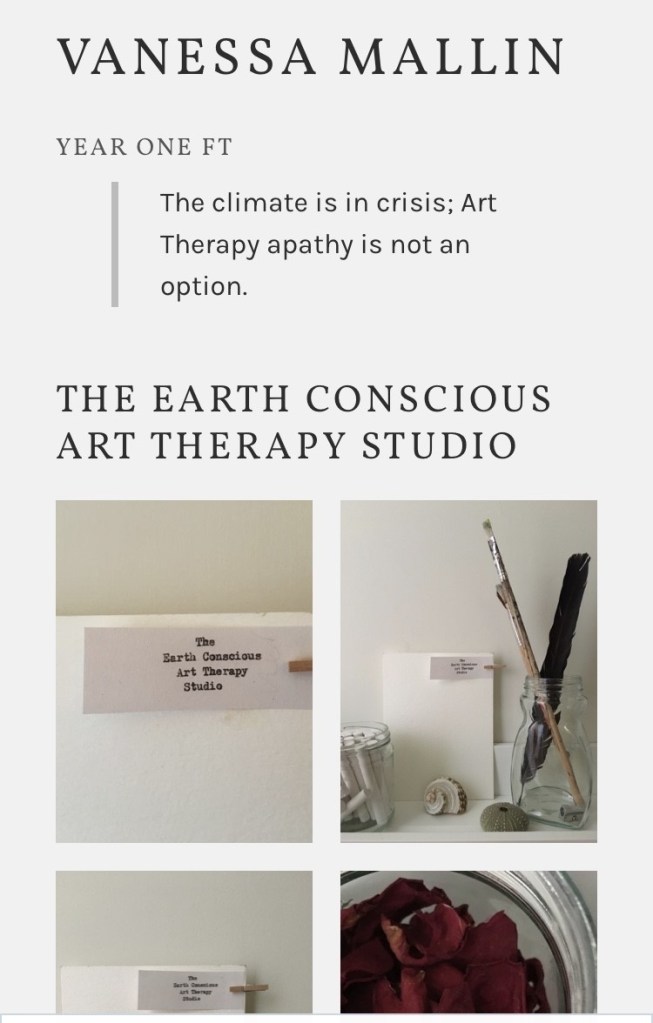
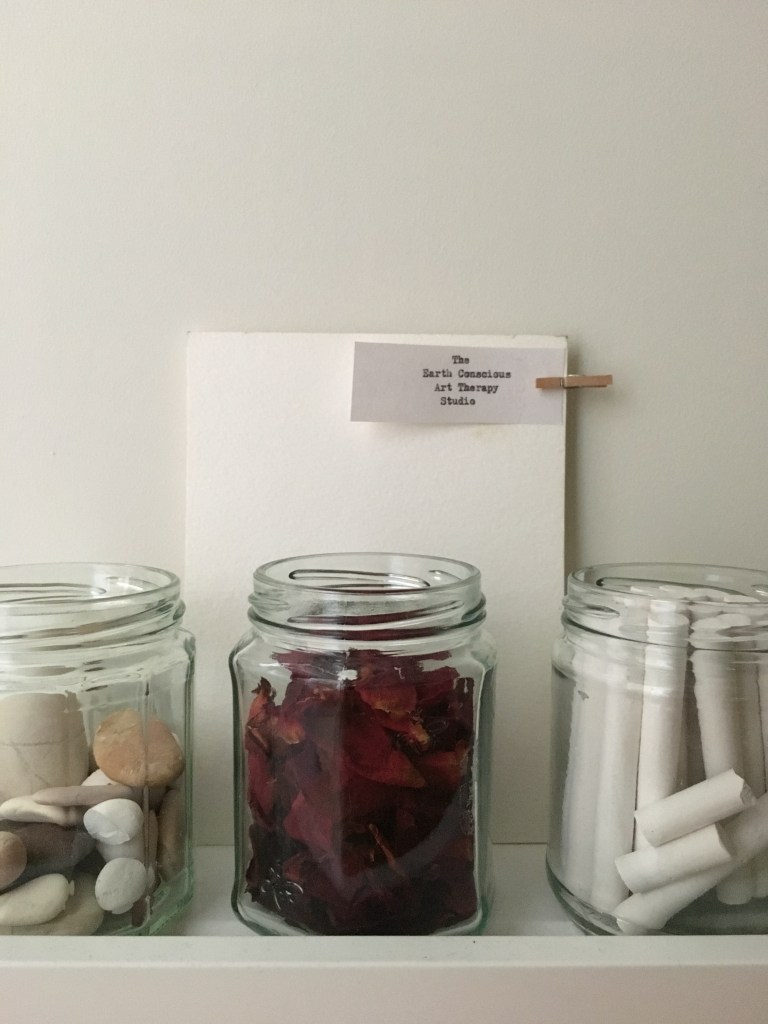
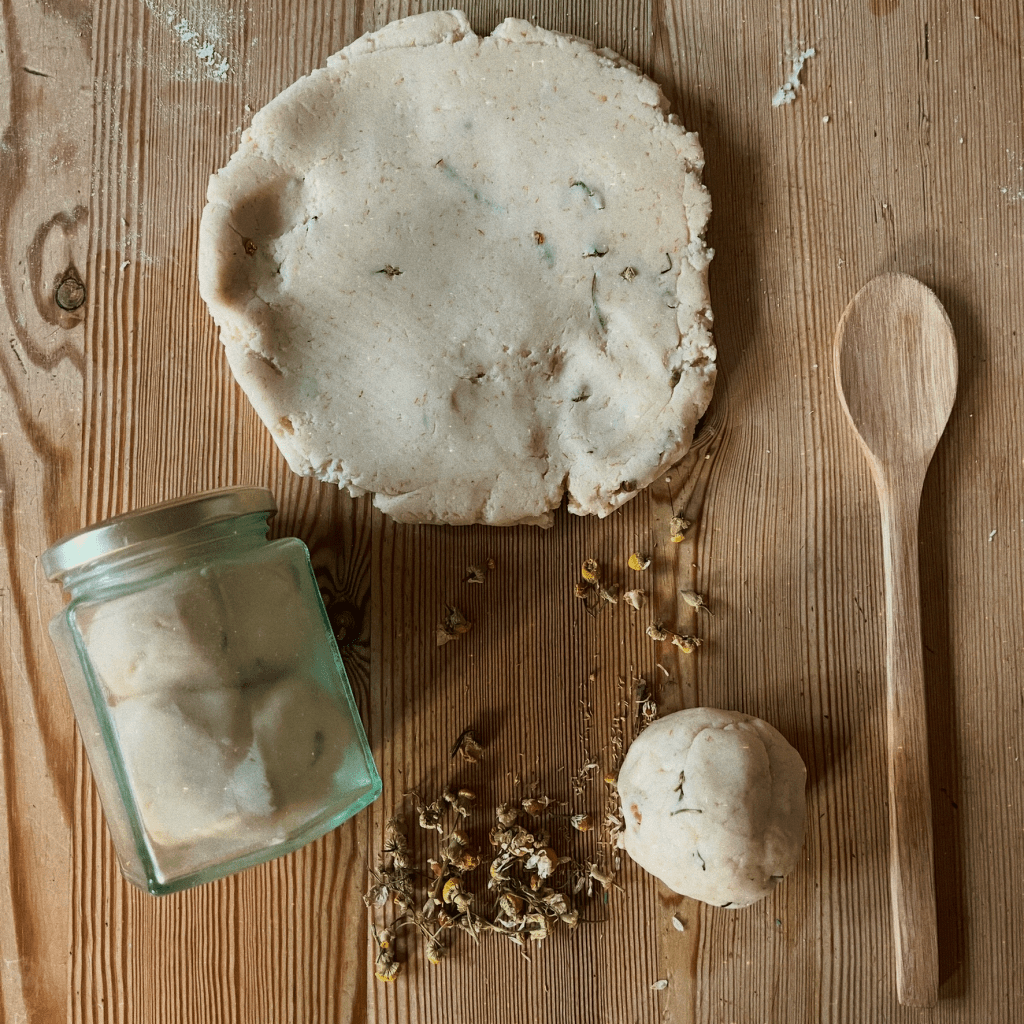
My artwork entitled ‘The climate is in crisis: Art Therapy apathy is not an option’ explored these ideas and formed the basis for my imagined earth conscious Art Therapy studio, equipped with natural playdough, plant based paints, shells, stones, feathers and dried flower petals. I also created an earth conscious Art Therapy contract which highlighted the issues around what it means to commit to ‘safety’ in an ever increasingly unstable world:

The Earth Conscious Art Psychotherapy
Contract with a Child

This is a safe place:

1.	The paints on the shelf are made with natural ingredients   without solvents or VOCs 
2.	The playdough has been made with everyday kitchen ingredients so is safe to handle and even ingest 
3.	The glitter in the jar is biodegradable so can be poured down the drain without damaging sea life or contributing to microplastic waste  
4.	The paper you are drawing on has not contributed to deforestation and the destruction of wild species 
5.	There is a bin for all waste which will be sorted and recycled 
6.	The toys you can see were made locally with sustainably sourced wood 
7.	When we wash our hands the water that flows out of the tap is rain water that has been collected from the roof above us
8.	There is a fabric towel to dry our hands which gets washed and reused
9.	Some of the furniture we are sitting on is second hand and some has been upcycled
10.	The walls surrounding us are not leaking lead or phthalates (which have been linked to causing asthma and cancer)
11.	The light above our heads is powered by renewable green energy and therefore does not rely on releasing carbon dioxide into the atmosphere 
12.	You can hear children outside in the playground because they are not striking from school in order to fight for climate justice 
13.	The building we are in is not being flooded because the climate is not in crisis